
Insights from Ocean Energy Europe 2025: European Leadership in Ocean Renewables

Updated: Sep 29

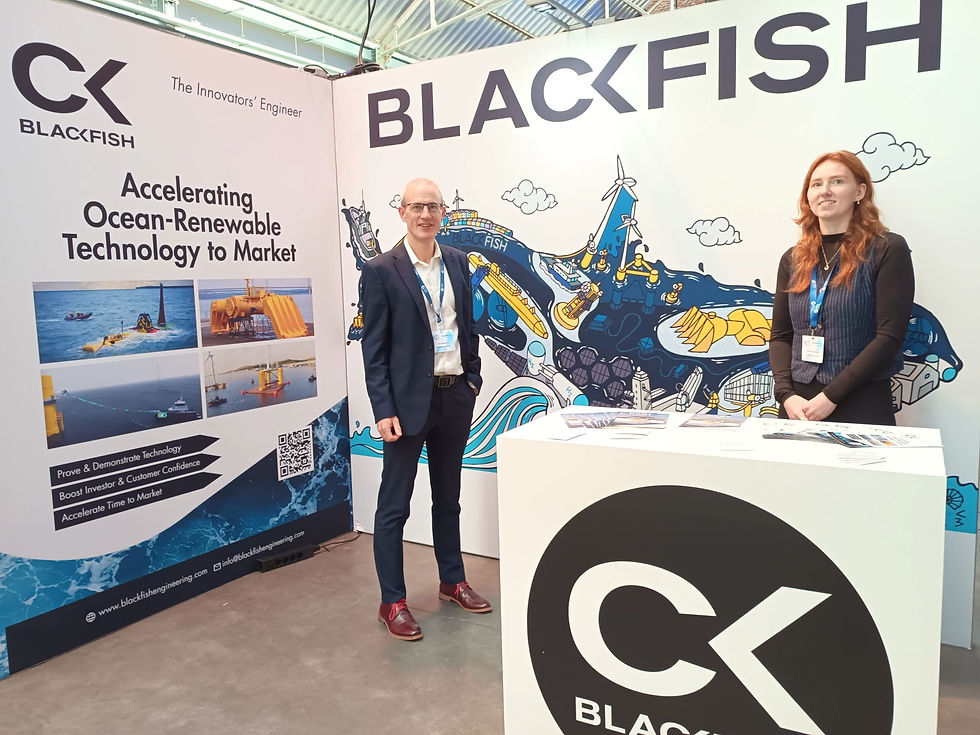
In November, the Blackfish Engineering team attended the Ocean Energy Europe (OEE) Conference 2025 in Brussels, Belgium. Bringing together developers, researchers, and industrial partners, the event highlighted how European ocean energy is evolving from experimentation to industrial-scale deployment.
With over €160 million invested and a public-funded pipeline now in place, the conference underscored the emerging role of ocean energy as both a decarbonisation driver and a European industrial strategy. For Blackfish, OEE offered the chance to connect with key players, strengthen our brand presence, and explore opportunities that accelerate the deployment of wave and tidal energy solutions.
Experiencing the “Made in Europe” Momentum
The conference theme, “Made in Europe,” captured the sector’s focus on regional industrialisation, local jobs, and value retention within Europe. Keynotes emphasised that public funding is unlocking private finance, creating a credible bridge from R&D to commercial deployment.
Highlights included:
Policy frameworks: The European Commission’s Ocean Pact and the Innovative Renewables 2030 strategy are supporting revenue mechanisms such as feed-in tariffs and contracts-for-difference, crucial to bankability.
Industrial pipeline: 17 EU-based suppliers now serve an emerging network of ocean-energy projects, with 15 new farms forecast over the next five years.
International collaboration: The US DOE has invested over $600 million into marine renewables, signalling parallel development pathways and opportunities for transatlantic partnerships.
Wave Energy: Practical Innovation and Scalability
Wave developers focused on pragmatism and simplicity, reflecting a shift toward repeatable, deployable solutions. Key takeaways included:
Seaturns: 200 kW single-moored floaters with internal pendulum and air turbines; full-scale deployment planned for 2026 near Bordeaux, with LCOE estimates of €30–80/MWh.
CorPower Ocean: Fully validated 300 kW “Stage 4” device delivering 600 kW to the grid; modular arrays scalable to 100 MW+; manufacturing based in Portugal, certified to EC standards.
Hybrid approaches: Blue-Economy integration, such as aquaculture and coastal protection, is creating near-term markets and blending resilience with energy production.
Across the sector, IEC standards, verification and validation frameworks, and digital twins are increasingly embedded in design and operations planning to de-risk deployment.
Tidal Energy: From Demonstration to Industrial Deployment
Tidal energy is entering a new phase of industrialisation, driven by both academic and commercial partnerships. Highlights included:
Minesto: “Flying kite” turbines with €150 million investment; Faroes project aiming for 100% renewable electricity by 2030.
Nova Innovation: First tidal array installed in Shetland (2016); lessons on permitting and deployment timelines across different geographies.
AMPEAK / MeyGen: Redesigned 18 m rotors delivering 12 GWh per year, with Phase 2 expansion through 2031.
Orbital Marine, Magallanes Renovables, Inyanga: Mature projects demonstrating bankable pipelines and EU-based supply chains.
Across presentations, a clear convergence emerged: success relies less on technological novelty and more on engineering discipline, standards compliance, and external verification. Test sites such as EMEC, BiMEP, and Blue Accelerator function as structured gateways from prototype to ocean deployment.

Blue-Economy and Regional Growth
Speakers highlighted the broader socio-economic benefits of ocean energy:
Job creation: Normandie projects alone are expected to deliver ~800 jobs.
Regional integration: Wave modules supporting coastal protection and energy infrastructure, combining resilience with decarbonisation.
Local industrialisation: European manufacturing, installation, and maintenance are positioned as key competitive advantages.
Key Takeaways for Blackfish
For Blackfish Engineering, OEE 2025 confirmed that Europe is shifting from demonstration projects to reliable, industrial-scale deployments.
This presents opportunities to:
Strengthen EU presence through partnerships and potential local offices.
Engage in early-stage advisory roles and technical collaborations with OEMs, developers, and test centres.
Position our engineering expertise to support bankable and scalable tidal and wave projects.
Maintain consistent visibility and thought leadership through digital and in-person engagement.

Looking Ahead: OEE 2026
Next year, Ocean Energy Europe will co-locate with the International Conference on Ocean Energy (ICOE) in The Hague. For Blackfish, continued involvement - through sponsorship, technical engagement, and market-facing activities - will be key to remaining at the forefront of the European ocean energy sector.
📩 If you are developing a wave or tidal energy project, we would love to explore how Blackfish can support your journey from concept to commercial deployment. From design and verification to operational planning, our services help technologies reach market faster, more reliably, and with reduced risk.


Comments